Eat Wild on the Road: Foraging Tips from Langdon Cook
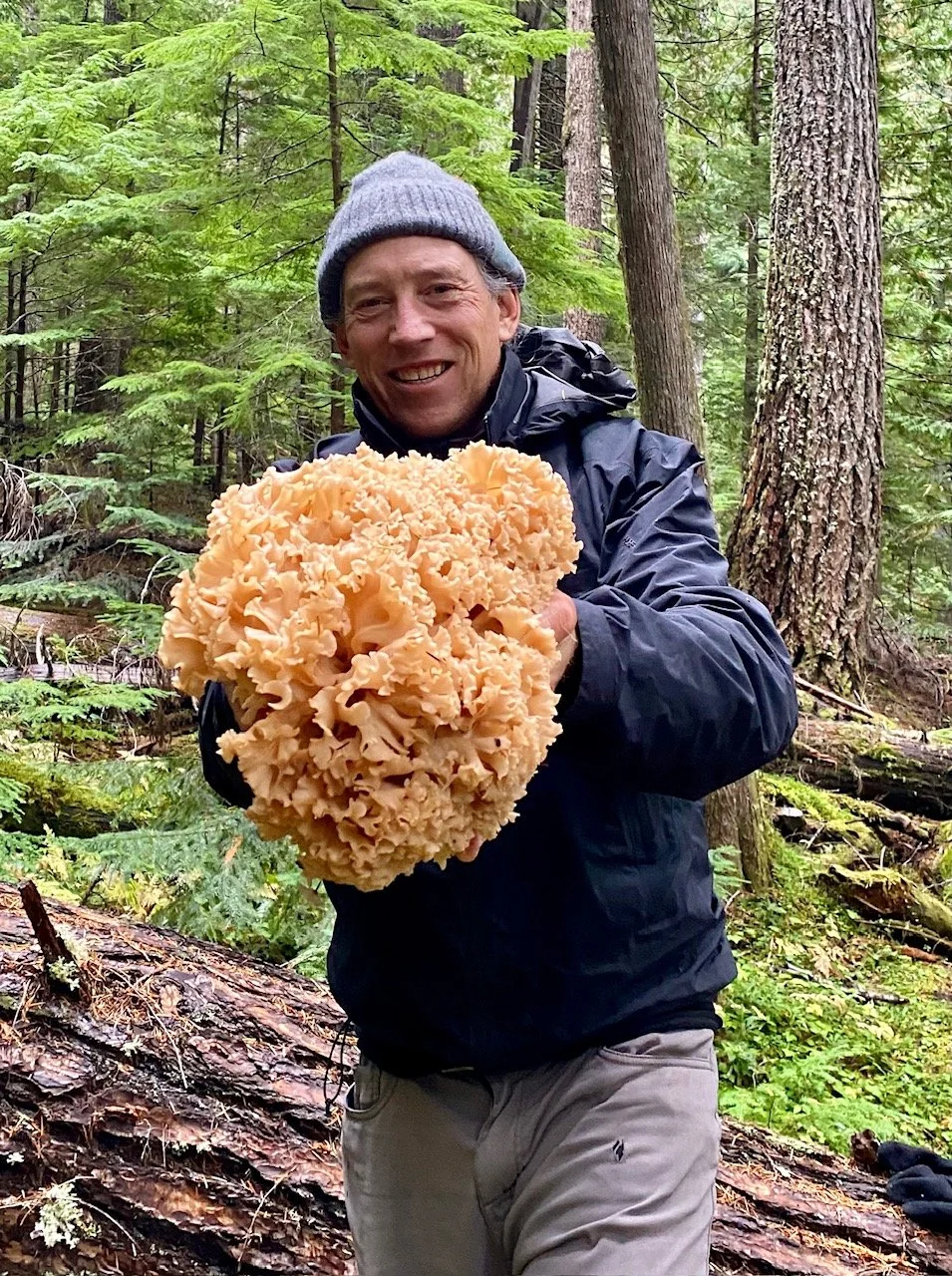
Seattle author and expert forager, Langdon Cook, holding a sparassis mushroom in the woods of the Pacific Northwest.
RV travel invites us to explore wide landscapes, open roads, and the freedom of the outdoors, but there’s another layer to that experience waiting just beyond the trail. This conversation explores how foraging, wild foods, and campfire cooking connect RVers to the land in a more personal and rewarding way. It’s about slowing down, looking closer, and discovering what the forest has to offer right around your campsite.
For many travelers, the idea of foraging can feel unfamiliar or overwhelming at first. Where do you begin? What is safe to pick? How do you turn wild ingredients into a meal you actually want to eat? This discussion helps take the mystery out of that process and opens the door for beginners who want to try something new on their next RV trip. From wild greens to chanterelles and morels, the outdoors becomes both your destination and your pantry.
Guest Langdon Cook is a Seattle-based author known for three books that explore wild food culture: Fat of the Land, The Mushroom Hunters, and Upstream: Searching for Salmon from River to Table. His writing blends storytelling, ecology, and food, offering a deeper look at how wild ingredients shape both people and place.
Together we talk about foraging as part of outdoor adventure travel, how it fits into RV living, and why it continues to draw people back into forests and campsites across the Pacific Northwest and beyond. If you’ve ever considered adding foraging to your camping routine, this conversation offers a grounded place to start.
SHOW NOTES
RV travel is often associated with scenic drives, national parks, and campground stays, but there is another layer of outdoor living that many travelers overlook: wild food foraging. In this episode, we explore how RVers can connect more deeply with the land by learning to identify, harvest, and cook wild foods found right around their campsites.
Joining the conversation is Seattle author Langdon Cook, a well-known voice in the world of wild foods, hunting, and seasonal eating. His work bridges storytelling, ecology, and food culture, showing how ingredients from the forest and rivers can shape both meals and meaning on the road.
Topics Covered in This Episode
Introduction to foraging for wild foods while RVing
How beginners can safely start foraging on camping trips
Common wild foods in the Pacific Northwest including mushrooms and greens
Using foraged ingredients for campfire cooking and RV meals
Why slowing down and observing nature changes your travel experience
The cultural and ecological importance of wild food gathering
About Langdon Cook
Langdon Cook is the author of three influential books on wild food and outdoor culture:
Fat of the Land
The Mushroom Hunters
Upstream: Searching for Salmon from River to Table
His writing explores how foraging and wild food traditions connect people to place, especially in regions like the Pacific Northwest. Learn more about this books.
Learn more about him here: Langdon Cook (author)
Wild Foods Mentioned
Wild Foods Resources
Why This Episode Matters
For RV travelers, campers, and outdoor enthusiasts, foraging offers a new way to experience familiar destinations. Instead of simply passing through landscapes, you begin to understand them on a deeper level—what grows, when it grows, and how it can be used in simple, fresh meals right at your campsite.
This conversation is ideal for anyone interested in RV living, outdoor cooking, sustainable travel, and exploring the natural world beyond the roadside view.
Listen & Subscribe to RV Out West
Don’t forget to subscribe to RV Out West for more episodes about RV travel, hiking destinations, and outdoor adventure across the western United States.
👉 Sign up via the link in this episode description or visit: https://rvoutwest.com/newsletter
Follow the Journey on Social Media:
Podcast Episode Transcript:
Eat Wild on the Road: Foraging Tips from Langdon Cook
0:00:00 Speaker 1: What if the forest around your campsite was hiding gourmet meals right in plain sight? This week, we're joined by Langdon Cook to talk about wild foods, mushroom hunting, and the hidden world of foraging across the Pacific Northwest. This episode might completely change how you see the woods around you. Welcome to RV Out West. I'm Brooks, based in the Pacific Northwest. My family of four hits the road to explore the best of RV life out west. From hidden gems and epic destinations, to helpful tips and real road stories. So grab your coffee and join the journey. Hey friends, I hope you are all able to make it out camping this weekend and hopefully you're listening to this on your drive home from a long holiday weekend. I still can't believe this is episode one hundred ninety nine. With each episode, we are getting so close to that magical number of episode two hundred, which is going to drop one week from today. The tattoo is scheduled for Thursday, June fourth. So you are going to want to make sure you're giving us a follow on Instagram and Facebook, as I'll be revealing the ink that evening after I've had my session with the artist, and I am so excited to share it all with you today on the show. I am really excited to have a local PA author on. We are going to be talking all about foraging. I've read all his books. Taking one of his foraging classes, he held back on Tiger Mountain over a decade ago. So it really is an honor to have him here on RV out West. While RVing is all about adventures and exploration of our natural world, it seems like a great fit to have him talk with us about a more micro look into the landscapes that surround us when we are all out camping, foraging, outdoor cooking, campfires all go together and maybe it's an activity that you've thought about adding to an RV trip and you're overwhelmed on where to start? Or perhaps it's never even been on your radar as something you want to try. But either way, it's a really fulfilling activity. And to be able to come back to your RV after a day deep in the woods with wild greens, maybe some chanterelles or morels to cook up in camp is just one other way to elevate your camp cooking. I hope that this conversation inspires you to try something new on your next trip. Seattle author Langdon Cook has written three books, fat of the land, The Mushroom Hunters and Upstream. Searching for Salmon from River to table. Each of his books carry a narrative about the impact wild foods can have on you, as well as in our society. I am beyond excited to welcome Langdon on the show. Langdon, thank you so much for joining us here on RV Out West.
00:02:56 Speaker 2: Good to be with you. Thanks.
00:02:58 Speaker 1: Can you briefly just give a little bit of your backstory and bio to.
00:03:03 Speaker 3: Our listeners who may not be familiar with who you are and the types of things that you do?
00:03:08 Speaker 2: Well, I'm a writer and instructor, but I kind of came by that title somewhat accidentally. In fact, you could call me an accidental forger. I moved out West more than thirty five years ago. I'm from New England originally. As soon as I graduated from college, literally the day, the day after graduation, I sort of did the traditional American thing of heading west, breaking down along the way and spending a winter in Taos, New Mexico, which wasn't so bad. And then on to, you know, the land of milk and honey, California, where I spent a couple of years doing newspaper jobs before moving up to the Pacific Northwest to go to graduate school at the University of Washington, where I was in the writing program there. After that, I sort of kicked around wondering what I was going to do. My girlfriend, who would later become my wife, sort of fell into the academic world and became a college professor, but I was a little more restless. It took me a while to sort of find my footing, but I spent time with old media, new media. And then when we had a three year old, I quit my new media job and parachuted into the woods of Oregon with my family, where we lived off the grid in the rogue River Canyon of southwestern Oregon for a year.
00:04:36 Speaker 3: Were you living in a year or were you did you build something or what? Were you living in an RV? What were you doing?
00:04:42 Speaker 2: We were living in a very rustic cabin with few amenities. Of course, there was no electricity there, but we did have a gravity feed water system. Water came from a spring. It was delicious. Cool. And we had solar panels that could actually heat an indoor, you know, water system for showering and, and that sort of thing. And so it was actually a pretty well appointed cabin considering where it was. I mean, it was it was deep. It was two hours from the nearest town by logging roads, which would have been Grants Pass, you know, maybe a half mile hike down to the rogue River from the cabin, which is we spent a lot more time on the river than in town, let me put it.
00:05:23 Speaker 3: That's really cool.
00:05:24 Speaker 2: It was an amazing experience. My wife, uh, was a poet and this was this cabin experience was part of a writing residency.
00:05:34 Speaker 3: So cool.
00:05:35 Speaker 2: Yes. Phenomenal experience.
00:05:37 Speaker 3: Were you writing then too? So were you also kind of using it as a writing in residency?
00:05:42 Speaker 2: You know, throughout my career, my various jobs had always been editorial related, but I really wanted to do some writing for myself. I mean, that had been the original reason why I had gone to graduate school. You know, I thought I had a novel in me. But what I discovered when I was down in the rogue, because I started sort of chronicling that experience, what I discovered was that I could use the same toolbox as a novelist, you know, character development and setting and narrative drive and, you know, all those sort of things that are important to the novelist. I could use it to tell a nonfiction story as well. And so my first book, fat of the land, which is a collection of personal essays about foraging and really developed out of that experience of living off the grid, that book, it was, it was told somewhat in a first person journalistic way. But really, the chapters are almost like short stories. Yeah. And I and I populate the cast of characters is really it's just my friends from from, you know, from life and from just getting out there and, and looking for wild foods. And then, and then after that, I would write a couple of books that were much more journalistic. But again, they really rely on sort of characters that you follow throughout the books, as well as the various settings where the book takes place mostly in the greater Pacific Northwest.
00:07:16 Speaker 1: Langdon, can I ask you something? Was there ever like a specific moment where things just kind of clicked for you and you were both kind of as the author and a forager where you're like, okay, this is what I want to write about. Or was it more of a slow evolution for you to kind of have that epiphany?
00:07:33 Speaker 2: No, I think you're right. I think it did. It's the former. It clicked for me. So we were living off the grid and just, you know, we were sort of forced to do a lot of foraging when we were there because we were two hours from town and we made trips to town maybe every, you know, ten days or two weeks or so to get groceries and pick up mail. But otherwise, you know, we relied on what we had in the freezer. And then, you know, we had this abundance of, uh, of, of wild foods around us, plus the foods that we were growing. So we had a huge vegetable garden. There were orchard trees on the property, but then we supplemented with quite a bit of foraging. I fish the rogue River for salmon and steelhead. There were wild greens all over the property. And then in the fall there was just a parade of mushrooms. And so, you know, we could really sort of add to our plate with interesting foods that we were finding on the property. Berries and greens and mushrooms and fish. Yeah.
00:08:39 Speaker 1: I love salmon berries.
00:08:41 Speaker 2: Do you, you know, salmonberries are great. But that's the that's the Rubus genus, which includes all the blackberries and raspberries, and there's so many other, even more delicious berries in that genus. And we had wild raspberries on the property. And, um, we had, you know, all sorts of blackberries that the bears absolutely loved. There was one particular bear that we got to know. Well, because he would do his foraging pretty close to the cabin. And my three year old got to know him quite well. And we called him Houdini because he had the he had the ability to sort of pop up in these funny places where you didn't expect him and then disappear. And the BlackBerry ramble brambles were so extensive, he had trails through them. We couldn't really get into these. It was way too thorny for us, but we could watch him from our deck as he would sort of pop his head up and then, you know, a minute later he was sort of twenty yards away popping up again. Yeah, yeah.
00:09:40 Speaker 1: You know, you've built your career around something most people typically walk right past in the woods. What was it that first pulled you into foraging these foods?
00:09:51 Speaker 2: As as we were harvesting them, I was writing about them as well. When we lived off the grid, I maintained this was the very earliest days of blogging, and now we sort of roll our eyes when we think about blogs. But they were exciting in those initial years. And I would write down just sort of our adventures off the grid and get some digital photos together. And I would go to town and I would go to a coffee shop in town, and I would upload all this material to this sort of nascent blog. Purpose of this was not literary. It was simply to let our friends and family know that we were okay. You know, we're still alive. We're living in the wilds of Oregon. You're not going to hear from us very often. But when you do, I'm going to tell you a few tales about what we're up to. That was basically the purpose. And so I found myself, you know, writing these sort of vignettes about our life out there, and a lot of it revolved around wild foods. What I realized was that these foods were characters in their own right. They have wonderful natural histories. They have wonderful histories of how people have used them, both in North America and elsewhere, and how indigenous people have used them. And so I found that these foods, they became my characters in a way. Right. And that's you would ask me sort of what clicked. And that was really what clicked for me, that I could write about these wild foods and do it almost like a novelist, you know, or short story writer.
00:11:28 Speaker 1: Did you forage when you were growing up out in New England, or did you come to foraging later in life? Kind of. How did foraging become a big piece of it?
00:11:37 Speaker 2: Yeah. As I said earlier, I was sort of an accidental forager. Um, as a kid, I was, I was definitely a nature boy. I was an only child for the first seven years of my life, until my sister came along and we lived on four acres of woods in, um, in Connecticut. And I just rambled around those woods, turning over rocks, you know, filling up terrariums with insects and that sort of thing. And I knew all the birds. And I had a neighbor who kind of encouraged me in this direction. And then actually, um, my grandparents were quite great about it. They used to take me to the Everglades. I just, I learned so much about nature and natural history with them, and just on my own kind of solo wanderings around our woods. And so I had that with me. But as soon as I got out West, I just, you know, there was something about the landscape. You know, even as a New England boy, I just I loved it in the West. I kind of realized this was my spiritual home. Immediately, I just started doing things in the outdoors. I was doing a lot of outdoor sports and recreation that you might not associate with foraging, like mountain biking and backcountry skiing and backpacking. But when you think about it, you know, if you're fifteen, twenty miles away from a trailhead and spending a few, you know, nights next to a beautiful alpine lake, if you can catch a trout and, you know, rustle up a few fiddleheads and some morels, well, you've got a delicious camp meal right there. That's certainly better than anything that you can get at Rei in one of those, you know. Yeah. In one of those astronaut freeze dried packages. And so Wild Foods started landing on my menu pretty much as soon as I got to the Pacific Northwest. And I just kind of, you know, added to my plate every year until by the time we went to Oregon to live off the grid, I really, I had a pretty big menu of wild foods. It wasn't something that I thought much about, but at that point I was starting to kind of internalize their seasons, you know, where I could find them, what foods they went well with in terms of in the kitchen, you know, culinary. That's really yeah, that's how I got into cooking was with the wild foods because I felt like if I was going to bring home these really wonderful foods that if you went to the farmer's market, some of them, you know, command quite a price. They're here, they're among us. And I'm taking them and, and eating them. And I felt like, well, I need to do them justice, you know? So that's really what encouraged me to become a better cook.
00:14:15 Speaker 1: So tell me, what's the most memorable meal you've ever created with something you've gathered yourself.
00:14:21 Speaker 2: Oh, I mean, there's so many.
00:14:23 Speaker 1: You just share one.
00:14:25 Speaker 2: Okay, I'll share one because it's kind of fun. I do a lot of Sichuan cooking, and I actually had a chance to go to China when I was doing research for my book, The Mushroom Hunters, because they have just a wonderful mushroom culture over there that's existed for thousands of years, and I wanted to see what their commercial mushroom culture was like. I spent some time in Sichuan Province. I actually took a cooking class when I was over there, and I and I love to do it here in my own kitchen. I think it's a sort of cuisine that probably intimidates most home cooks, but if you have a few good ingredients and just a couple of techniques, you really can duplicate some of those dishes that you love from a from a Chinese restaurant. Morel season and gooey duck season happened to coincide. And for listeners who don't know what a gooey duck is, that's our largest burrowing clam in the world. Actually, we happen to have a lot of them in Puget Sound, and they can be enormous and they can live to be two hundred years old. They can be double digits in terms of weight. I mean, they're just huge and they're absolutely delicious. But gathering a gooey duck takes a lot of a lot of effort. They, they tend to be three or four feet down in the muck, and you can only get them on the lowest tides of the year. And of course, those tides usually coincide with the summer solstice. That is also a great time to be out looking for a type of morel that here in the West we we generally call burn morels. And the burn morels are the morels that come up after a forest fire. A lot of people now have heard about these morels. They've sort of gained in popularity. And if conditions are right and you're in the right habitat and there's been a forest fire the previous year, which of course is, you know, ecologically typical for the West, you might just have this incredible abundance of morels popping up. And so I like to do this sort of surf and turf Sichuan dish that combines two things. I just love to do so much, which is looking for morels. Because even even with burn morels, it's a little bit of a treasure hunt because you really have to put the pieces together. I think of it as sort of nature's Rubik's Cube, where you're constantly figuring out all the combinations, you know, to get all the colors to line up. You know, there's slope aspect and moisture and soil type and tree canopy and season elevation and all these things. You have to get it right in order to find those mother loads of morels. But when it comes together, you can go home with baskets and baskets of morels. Then you head to the coast. If it's a low tide, I'm talking about like a negative three foot to negative four foot low tide. Get your shovels and get a few friends to help you, because you're going to be digging a hole that might end up looking more like a hot tub as the Nisqually term for gooey duck, it means dig deep and you do have to dig deep. And then even then, the clam is kind of vacuumed into its layer. It's sort of it's sort of stuck there. And that's where it spends its whole life. But it's kind of you have to sort of you have to break that suction. You have to get underneath the shell with your hands to kind of break the suction and finally pull it out. And I mean, you're just going to get soaked. I wear my fishing waders. I bring a change of clothes. I know that I'm going to be soaked after getting a gooey duck. But if you're successful, you've got a giant clam, which I like to tell people. It's just. It's like the clam of all clams. You know it, I love it. It has incredible clam flavor. It's there's a lot of it. I usually use the siphon for sashimi. And then I use the body meat for stir fries. Uh, and I'll dice up the body meat. And when you throw it into the wok, it just immediately plumps up. It's it's so delicious. So what I like to do is I do a very quick stir fry. It's kind of like a kung pao with, with the morals and the gooey duck. And all of this happens in the space of about five minutes. Sichuan cooking is mostly prepping. You're prepping your ginger and your garlic and your green onion and other veggies that you might be throwing in. You're making your sauce ahead of time. Maybe if it's kung pao, you got to get your peanuts ready. Got to get your spices ready like your six one peppercorns and your hot peppers. Uh, but it all goes into the wok very quickly. Your your flash frying it. And of course, the mushrooms, morels need to be cooked. That's an important thing about morels. You cannot eat them raw. Um, they have some natural compounds in them that will make you sick. But just with some heat you cook that off. It's fine, but you need to make sure they're cooked well. And then the geoduck goes in there. And all of this happens in probably less than five minutes. And you've got an incredible surf and turf Kung POW at the end. And I love to cook that for people who are just like, right on the coast with me maybe doing some oystering and some clamming and so good. Yeah. And just to walk over the fire, you know, it's, uh, it's pretty special.
00:19:44 Speaker 1: We've been talking all about these incredible wild foods you can forage and the amazing meals you can create from them. But how do you actually get started when we come back from the break? Langdon's going to talk to us about the first steps into the world of foraging, what beginners need to know before heading out into the woods, and how to safely start finding your own wild food adventures. So stay tuned. You're listening to RV Out West. But first, let's hear a word from our longtime sponsor and friend over at camper alerts dot com. Sold out campgrounds used to mean one thing. Game over. Not anymore. Camper alerts keeps watch on the most in-demand, hardest to get into campgrounds out there. The ones that are booked solid for months, and the moment a site opens up, you get the alert. No constant checking, no luck based refreshes, just real time access to cancellations and openings before they disappear again. That dream spot everyone is fighting for. You just got a shot at it. Say goodbye to sold out campgrounds because full doesn't have to mean finished. Visit camper alerts dot com and start setting your alerts today. And welcome back to RV Out West. Before the break, we were talking about some of the incredible wild foods you can forage and the amazing meals you can create from them. Now we're going to shift gears and talk about how you can safely get started foraging your own wild foods from the basics. Every beginner should know to the mistakes you're definitely going to want to avoid. Let's get back to our conversation with Langdon Cook.
00:21:27 Speaker 4: When you first maybe step into a forest, What are you noticing that you think the average person is not paying attention to?
00:21:37 Speaker 2: When I teach my classes, especially for mushroom hunting, and this is unintuitive, but I tell people that the first thing that they need to learn is their trees. Not even the mushrooms. Really learn your trees first, because mushrooms have relationships with trees. Now they might have a symbiotic relationship. We call that a mycorrhizal relationship where literally the tree and the mushroom are exchanging water and nutrients and things like that, and they need each other. But then we also have mushrooms that are saprophytic, which means they, they basically live off of dead and decaying matter. But usually that matter is often a tree. And so you need to learn what sort of tree they like to grow on that they're munching on. And then there are parasitic fungi, which are which are eating living matter and again, often a tree. So they're essentially a parasite on the tree. And they will eventually kill the tree. But you need to know what kind of tree they prefer. So in all three cases, no matter what sort of game plan the mushroom has for its survival, whether it's mycorrhizal, saprophytic or parasitic, you need to know the tree host. So that's for mushrooms for other plants, wild greens, berries, nuts, that sort of thing. It really helps to sort of be able to develop in your mind's eye the right habitat. And often, again, that includes certain trees that you're going to find, but also a general just sort of look, if I'm, for instance, harvesting wild nettles in the early spring and I just have to put a plug in for nettles because I know that a lot of people have had bad experiences sort of meeting the business end of the stinging nettle. Yeah. You know, certainly a lot of us when we were kids and we were rambling around the woods, had an encounter with stinging nettles that didn't go so well. Perhaps we have some negative feelings about that. I probably forage more stinging nettles than any other wild green in the spring, and that's because a they're delicious. B they're everywhere and you can't possibly put a dent in their population. And C they're actually an invasive weed. And so for instance, where I live here in Seattle, I think the Parks department lists them as a noxious, invasive weed. And they'd probably like to get rid of them. That said, you're still not allowed to forage nettles out of a city park.
00:24:10 Speaker 4: That's interesting. I made a nettle pesto one time that was absolutely fantastic. I used nettles instead of basil and made pesto sauce.
00:24:18 Speaker 2: Yeah, that's a go to for me.
00:24:20 Speaker 4: Yeah, it was great.
00:24:22 Speaker 2: I probably make more nettle pesto than just about any other dish with wild greens. And what I do is I like to make a creamy pesto, and I. And I do it the traditional way that you would with basil, lots of olive oil.
00:24:34 Speaker 4: Garlic and garlic.
00:24:35 Speaker 2: Um, I usually use toasted pine nuts, but you could use walnuts as well. You know, parmesan, lemon juice, sea salt. I just wore that up in the in the Cuisinart or blender, whatever you've got until it's fairly smooth. And then I spread it into ice cube trays and I put those in the freezer. And in a couple of hours they've hardened up. I pop them out and I call those my my nettle pesto pops and they go into Ziploc bags. And each pop is about a single serving. And so let's say you've got some leftover pasta in the fridge. Well, you've got like an instant, like really healthy mac and cheese there. You know, you just microwave that with a cube of the pesto and it's delicious. But the real sort of great thing about this pesto is if I'm making sauces. So, you know, in the depths of a dark winter where, you know, at four o'clock, it's, you know, you're turning your outside lights on. You just want to have that kind of shot of spring. Will you take two or three of those pesto cubes and melt them in a pan with some diced shallot? Give it a splash of wine, then some chicken stock and let it reduce a little bit. Maybe add a little more chicken stock. You've got a wonderful bright green sauce that just speaks of spring. And then I like to cook other ingredients in that sauce. Or maybe I'll float fillet of halibut on top, but it's just it's delicious. So nettles are one of my my favorites. But you have to understand their natural history. Well, first of all, they're weeds. Okay. And so weeds like any sort of disturbance. And so the place to go for nettles are habitats that have been disturbed by us. That could be trailheads. It could be right along the sides of trails. It could be an old burn areas or blowdowns. It could even be, like right in the middle of the city in like, an abandoned, you know, lot. Those are the sort of places that will produce nettles. And you just have to understand that sort of habitat. I would say if you pick them in the abandoned lot in the city, just make sure that, you know, there wasn't a gas station there previously or an auto body shop or, or something like that.
00:26:54 Speaker 4: Don't want to eat.
00:26:55 Speaker 2: Yeah.
00:26:56 Speaker 4: You don't want to eat.
00:26:57 Speaker 2: Yeah. And you know, you're not going to find that information online, you know. So really the forager, I tell people, you just have to use kind of, you know, your common sense and be thoughtful. Yeah. So for instance, logging roads can be really great places to forage right alongside of like, you can just walk logging roads and find interesting greens and berries and mushrooms right on the sides, because a lot of these foods are kind of edge species. So they like where two habitats come together and form an edge. And often you've got sort of the woods and then you've got the road and right there there's an edge, right? Logging roads are great, but you gotta remember that logging companies will often spray their roads to keep vegetation down, and they do other things. You know, you really don't want those chemicals in your food. Same thing with if you're foraging, if you're doing some urban foraging. So like here in Seattle, we have all kinds of blackberry bushes in all our parks and alongside the roads and especially in the parks, like I'll talk to Seattle city parks and say, yeah, are you, are you spraying in this particular park these days? They're mostly trying to mitigate their blackberries because they just get out of control by sending work crews out, often volunteer groups just to pull them. And they're not, they're not spraying so much because they know that people in the city are picking those berries. And so they're mostly safe. But but it's a good idea to check. The other thing really, the golden rule of foraging is never eat anything from the wild without one hundred percent certainty of what it is. You can't just sort of graze your way willy nilly through the forest. Most things, plant and fungi that you might eat will just without knowing what they are, will just be unpalatable. But there are a few that are toxic. And so you really, you have to know, for instance, what wild watercress looks like, which is very toxic, kind of resembles parsley a little bit. So, you know, you might think, oh, we've got some wild parsley here. Now that's something you don't want to put in your mouth. Right. And same thing with mushrooms. Most mushrooms are just going to be unpalatable. Some are going to be incredibly delicious and a very few are deadly poisonous.
00:29:22 Speaker 4: We're going to talk about that here in just a second, okay?
00:29:25 Speaker 2: Okay.
00:29:25 Speaker 4: That's a great transition. You know, mushrooms have this almost mythical reputation. What makes them so compelling compared to other wild foods?
00:29:36 Speaker 2: I think with mushroom hunting, you're getting the full treasure hunt aspect. That's what turns a lot of people onto foraging. So I have quite a few friends who don't do that much foraging across the board with, you know, the different kingdoms plant and, and fungi, but they, they do enjoy mushroom hunting because it just, it feels like a special day when you're out there looking for mushrooms. It's really it's mushroom hunting has gained in popularity here in the US. It's kind of the poster child for foraging. Elsewhere around the world, people have been harvesting wild mushrooms for the table for centuries, if not millennia. Here we're a little bit micro phobic. It's only recently that we've warmed up to the idea of mushroom hunting, but I think now it's really catching on in popularity and it's easy to see why. It's just exciting to be out there on the mushroom hunt, to be able to find your own food in the forest. I think it takes us back to sort of, you know, this sort of prehistory when we were all foragers for a living. You know, you have to remember that we are the descendants of successful foragers in the deep past. They managed to survive without killing themselves, you know.
00:30:54 Speaker 4: Right, exactly.
00:30:56 Speaker 2: So we still have that in our genetic makeup. I'll take somebody out mushroom harvesting for the first time. And you can just see when they spot their first morel or their first chanterelle or porcino, that you could see the light bulb going off. I mean, it's just like, aw, going on, I should say. I mean, it really, you know, it's exciting.
00:31:18 Speaker 4: It's very exciting.
00:31:19 Speaker 2: The excitement, knowing that you're sort of bringing home the bacon.
00:31:23 Speaker 4: Yeah. Well, let me ask you. Yeah. What tips or suggestions do you have for somebody who's looking to get started in foraging? Where what do they need to know? I mean, sure, we all know the things that say, oh, you got to be careful what you eat, but where can they go to learn about things?
00:31:39 Speaker 2: Sure. So we already covered the first thing, and that is learn your trees, which might seem counterintuitive, but we've talked about why trees are so important to mushrooms. If you want to find a certain species of mushroom, you really have to know what tree it's growing with. Okay. We're actually lucky where I live in the Pacific Northwest because, and in fact, all over the West, I would say this is true because we don't have nearly as many tree species as, say, they they have back east, mainly in those broadleaf deciduous trees. That can be really bewildering when you're in the forest. All those different species here. You have to learn, you know, a few conifers. There are a couple hardwoods, but really, it's not that tough to learn your trees here. So that's number one. Learn your trees. Number two, I always tell people join a mycological society. That's probably the single best way to learn, especially if you're a newbie. For instance, my local Mycological society, the Puget Sound Mycological Society, has a guest speaker every month in season. There are forays and this is all free. And I think, you know, there's a nominal joining price. I think it's like thirty bucks a year for a family. So it's a steal. And you get to you get to go to the lectures, you get to go to the forays at the forays, you know, you might meet at a Forest Service campground somewhere, and then everybody goes out and scours the woods and then comes back again. And there's usually an expert identifier on hand who will tell you, you know what you've caught. Of course, there are people in the club who will point you in the right direction if you want to find wild edibles. Not everybody is interested in edibles. There's some people who are interested in doing the microscope work, and there's others you know who are interested. A lot of people, especially some of the younger folks, they're interested in psychedelics and that's their their first sort of brush with mycology. But then usually they end up getting interested in the culinary side too. There's all sorts of fun things. And of course, mushrooms are very hip these days for all their sort of amazing features, just scientifically, you know, we're using them for what's called mycoremediation. They can help, for instance, clean up oil spills or decontaminate water bodies and things like that because they just they have these amazing properties. And, you know, they found that mushrooms are eating the radiation at Chernobyl. That's so cool. Now, you don't want to go forward to those mushrooms, but it's a great thing. It's a great thing that we have them, right? That's great. They they can really cleanse the environment. Two things right. They're joining a mycological society and learning your trees. And then really you just have to get out there. It's boots on the ground. And remember, a day of mushroom hunting in which you get skunked is still a great day in the woods, right? So it's always fun.
00:34:36 Speaker 4: My next kind of question where I wanted to go with this is that what do you hope people ultimately gain from their knowledge and learning how to forage?
00:34:47 Speaker 2: So I think mushroom hunting and foraging in general is just yet another hobby that can help you interact with the natural world and maybe in the end, become a steward of that world. My hope is that there are lots of people getting out there, mushroom hunting, and it's gotten a little more competitive in the woods as a result. Uh, you know, there's all sorts of Facebook groups and, and, uh, and, you know, I see more people out there, but I welcome that. I think just having people outdoors is a good thing because we've kind of, we're losing our connection with.
00:35:26 Speaker 4: Our natural.
00:35:27 Speaker 2: Surroundings to the natural world. And I think it's really going forward. We've got so many things with climate change and just with diminishing wild places. We really need people out there defending these places. I think that foraging is a great way to really develop a relationship with the outdoor world.
00:35:48 Speaker 4: Rapid fire. Favorite mushroom.
00:35:50 Speaker 2: Porcini.
00:35:51 Speaker 4: Most underrated wild food. Ooh.
00:35:53 Speaker 2: I would say stinging nettles.
00:35:55 Speaker 4: Okay, one thing you've never foraged.
00:35:58 Speaker 2: You know, ginseng gets foraged quite a bit on the East coast. I've never done that.
00:36:03 Speaker 4: Best beginner mistake that taught you something valuable.
00:36:07 Speaker 2: I ate a mushroom. many, many years ago that I had psychosomatic symptoms. After eating it, I wasn't one hundred percent sure of the species, and I thought I'd made a grave mistake. Well, it was a queen bolete and there was no problem there. It was a it was an edible mushroom, but it was different from the boletes I had always found in the past, and I. But I wasn't sure exactly what it was, and I ate it. And I probably shouldn't have done that. I should have figured out exactly what it was because I was violating my own rule there to never eat anything without one hundred percent certainty. And as a result, it caused all these, like I, I thought, oh my God, I'm gonna have to go to the hospital, you know? But no, I was fine.
00:36:58 Speaker 4: It was a life lesson.
00:36:59 Speaker 2: And that was a long, long time ago.
00:37:01 Speaker 4: I learned early days of learning. Yeah. Okay. Well, let me ask you this. Where can listeners go to find more about your work and go deeper. Follow along on your adventures and learn more about you.
00:37:13 Speaker 2: I'd ask you to go to LinkedIn dot com. You can find tons of recipes for wild foods on my site, as well as my books. And I have three books we've talked about fat of the land. My other two books are The Mushroom Hunters and Upstream and upstream is all about Pacific salmon culture here in the Pacific Northwest. And The Mushroom Hunters is about the kind of underground economy of pickers and buyers in the edible wild mushroom business, which is really centered also in the Pacific Northwest, although the mushrooms get shipped all over the world from here. And it's a fascinating sort of subculture that I spent several years following and writing about.
00:37:58 Speaker 4: Well, LinkedIn, thank you so much for joining us here on RV Out West. I really appreciate it.
00:38:03 Speaker 2: Thanks for having me, Brooks. It's been a pleasure.
00:38:07 Speaker 1: All right, my friends. The conversation doesn't have to end here. If anything we talked about sparked your curiosity. Head over to RV Outwest dot com and take a moment to check out the show notes. We've got the links to everything we mentioned so you can dive deeper and explore more. If you enjoyed this episode, please share it with a friend or family member. If you haven't already signed up for our free monthly newsletter, visit our website at RV outwest dot com and get some insider info that you don't normally hear about right here on the show. Next week on RV Out West, we hit a huge milestone episode two hundred. And to celebrate, we're kicking off a special two part mini series that starts with a story that has been years in the making. We're talking with an RV couple who sold everything they owned and moved full time into an Airstream. But this isn't just another we hit the road story. I actually met them in a campground in Pennsylvania on their very first night of full time RV life. Before the routines, before their social media, before they knew what this lifestyle would become. Now, years later, we reconnect to hear what really happened after they took the leap. And somehow this journey all ties back to the Pacific Northwest. How you'll have to tune in to find out. Episode two hundred drops next week, and trust me, you don't want to miss this one. Thanks for listening to RV Out West. Be sure to follow the show so you never miss an episode. And if you enjoyed the show, tell a friend and please leave a rating or review. It would mean a lot. Special thanks to Scott. Home music for our intro song. We are one. Follow us on Instagram and Facebook to join in on the conversation. Now get out there, explore and go see what's beyond the horizon.